- Originally published: July 2025
- Updated: February 2026
Summary: Most organizations plateau at Level 3 of AI maturity, where 2x efficiency gains are eroded by quality issues. The AI Maturity Model (AIMM) is a five-level framework that helps businesses identify where they are, why they're stuck, and what it takes to break through to 10x productivity gains.
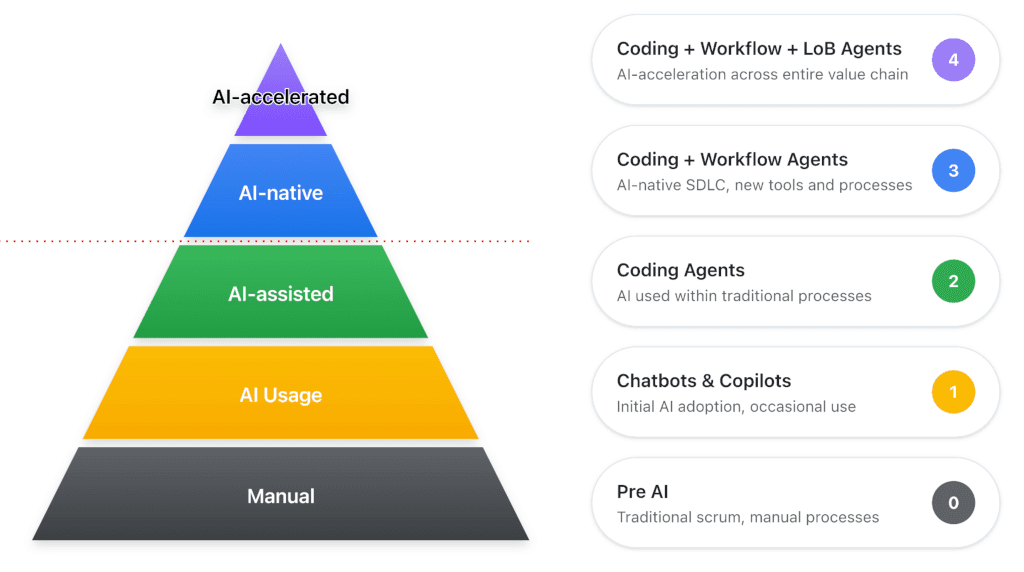
Having a roadmap to track your business’ AI maturity helps you navigate the rapidly evolving AI landscape. Understanding where you are and where you're headed next becomes crucial to achieving goal-oriented business outcomes. The AI Maturity Model (AIMM) is a framework developed by Sentrix to help you track your progress on your AI journey. This framework can help you assess your current position and chart a path forward. Equally important, AIMM can help you set realistic business goals based on your current level of AI Maturity.
The following table provides an overview of the maturity levels.
| Maturity Level | Theme |
|---|---|
| Level 5 | AI-acceleration |
| Level 4 | AI-native |
| Level 3 | AI-assisted |
| Level 2 | AI usage - Chatbots and Copilots |
| Level 1 | Baseline - No AI |
We'll begin by looking at each level from the bottom up, starting with pre-AI at Level 1.
Level 1: Baseline - No AI / Pre-AI
Level 1 is where every business starts. It's the pre-AI era where there is no AI usage at all.
This level is where you want to set your baseline efficiency, quality and operating metrics. It's how you'll track the ROI of AI investments.
If you're still at this level in 2026, don't fret. Many organizations still operate here, either due to regulatory constraints, resource limitations, or simply not yet recognizing the potential value AI can bring to their operations.
Key takeaway: Level 1 is where you establish baseline metrics which are crucial for measuring the impact of AI investments.
Level 2: AI-usage - Chatbots and Copilots
The first real step into AI adoption comes in two forms:
- First, teams begin using AI features that have been added to their existing tools. For example, grammar suggestions in document editors or smart compose in email clients.
- Second, employees start experimenting with AI chatbots and copilots for occasional tasks, perhaps drafting a blog post or brainstorming ideas.
At this stage, workflows and processes remain largely unchanged. AI is an occasionally helpful addition within processes. Most AI usage at this stage is limited to pilots, POCs or off-the-shelf tools.
Level 2 is also where an organization experiences the most shadow AI usage, which is where an employee uses a personal account that is not managed by IT. Shadow AI affects an organization's security posture.
Key takeaway: Level 2 involves sporadic AI usage within existing processes.
Level 3: AI-assisted - Consistent AI Usage
Moving to Level 3 is a key threshold for an organization. At this level the organization has major AI initiatives that start to formalize usage within teams, across departments and across the organization.
What differentiates Level 2 from Level 3 is the formalization of AI usage. In Level 3 an organization goes from experimenting with AI to making material investments and therefore creates a need to measure ROI.
As comfort grows, the business introduces AI Agents into the organization. While Level 3 is a key milestone, it's also where most organizations hit a productivity wall. The promise of AI is both visible and limited. It's normal for managers and leaders within the organization to start to question what's actually possible with AI. It's where there's a glimpse at a future where major productivity gains become viable, yet at the same time productivity is stuck at a 20% to 50% gain.
For engineering orgs, Level 3 is where the team is stuck in PR overload. AI is generating a substantial amount of code which is causing a backlog of PRs that demand attention from senior engineers.
AI-assisted is a key threshold as it's the level at which an organization starts to buckle under the velocity and volume of AI. Overall efficiency is up 20% to 50%, but the underlying metrics are more telling. AI is boosting efficiency by 2x and yet many of those gains are taken back by burdening the team with quality issues.
The key to breaking through to Level 4 is to redesign processes, retrain your team, and invest in AI-native tooling.
Key takeaway: Level 3 is where the business sees real productivity gains from AI, yet also gives some of those gains back due to quality issues.
Level 4: AI-native
Level 4 marks a significant shift in how the business operates. Processes and workflows are redesigned and reimagined to be AI-native. Employees are provided training on how to use AI effectively. AI-native technology and tools are adopted to replace legacy software.
Level 4 is where an organization sees undeniable productivity gains from AI, starting with 2x, then 5x, then 10x.
At this level, leadership often does a sanity check. The productivity gains are too high to be real, right? This is also when astute managers start to question traditional metrics. In the Product and Engineering orgs, traditional metrics like lines of code (KLOC), number of bugs fixed, or number of PRs lose their value. Forward-thinking leaders adopt business value metrics rather than productivity metrics. Why? AI makes traditional productivity metrics useless.
Rather than simply adding AI to existing processes, organizations begin redesigning their workflows with AI capabilities in mind. Companies start building custom systems and processes unique to their business needs, purpose-built to leverage AI's strengths. The focus is not automation. Instead, it's best to focus on a reimagination of how to combine people, processes and technology.
Key takeaway: Level 4 is where processes are reimagined into new AI-native workflows, team members are formally trained on AI usage, and where the business experiences sustainable 10x productivity gains.
Level 5: AI-acceleration
Very few organizations will achieve Level 5. At this level, the transformative power of AI becomes apparent in two key ways:
- Acceleration: The organization achieves a state of continuous measurable improvement. Metrics become relative and increasingly focus on velocity rather than simple speed metrics. Quality becomes a central focus of the organization as a means to protect efficiency gains. What once took days might now take hours, and what took hours might take minutes.
- Amplification: Because AI makes processes faster and more cost-effective, teams can do more of what they're already doing while simultaneously taking on new tasks. A content team might go from publishing weekly to daily. An engineering team may connect user telemetry to business goals stated in a PRD to close the loop on value creation. The scope of existing operations expands dramatically.
The highest maturity level represents true innovation. Organizations at this stage recognize that AI doesn't just make existing processes better, it enables entirely new capabilities. Companies begin developing new products, services, and ways to create customer value that simply weren't possible before AI. This is where competitive advantage truly emerges, as businesses leverage AI to do things their competitors cannot. Level 5 is earned so competitors cannot simply buy their way to competitive parity.
Key takeaway: Level 5 is rare and hard to achieve. At this level, the transformative power of AI becomes apparent in two key ways: Acceleration and Amplification. At this level a business can achieve sustainable competitive advantage.
Moving Forward
Understanding these maturity levels isn't just an academic exercise. It provides a practical framework for planning your AI journey. Where does your organization currently sit? What would it take to move to the next level? What barriers are preventing you from moving forward? Are the barriers technical, cultural, or organizational?
The progression through these levels isn't always linear, and different departments within the same organization may be at different stages. The key is to be intentional about your advancement, ensuring that each step builds toward a comprehensive AI strategy that aligns with your business goals.
As AI continues to evolve, so too will the possibilities at each maturity level. The organizations that thrive will be those that not only adopt AI but also adapt to AI. Leaders continuously push toward higher levels of maturity, always asking: "What's now possible that wasn't before?"