AI is radically increasing the velocity and productivity of software engineers. It's also accelerating product managers, designers, and other people involved in the product development process. However, these individual productivity gains can quickly create new bottlenecks if legacy organization structures and processes are not changed. At Sentrix.ai, we've found that the most successful teams are those that rethink their team structure to adapt to AI-native processes.
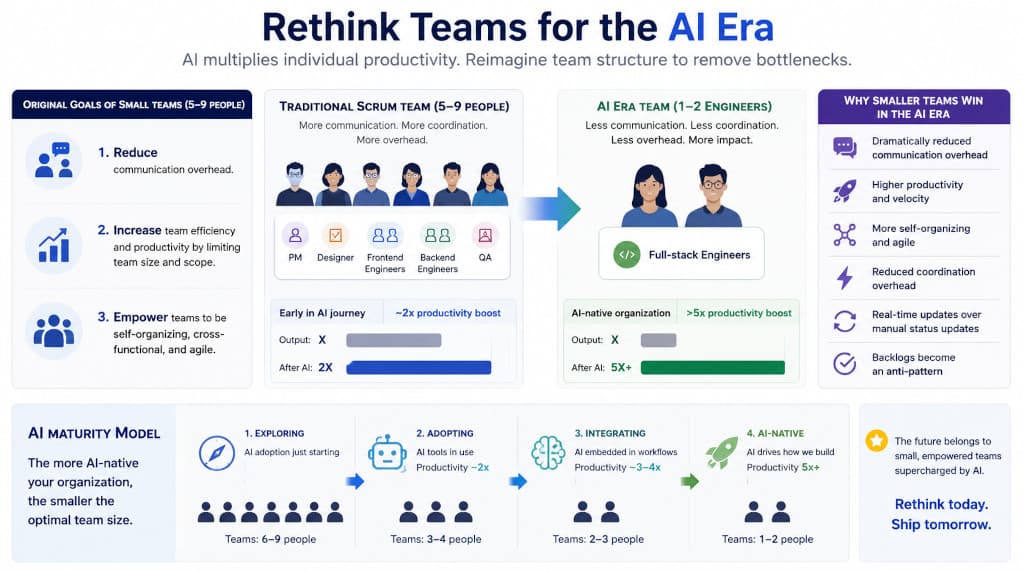
Most companies still have a traditional scrum team of 5 to 9 people. Before we reimagine our teams, I find that reviewing the original goals for creating these small 5 to 9 people is a good place to start. The original goals for these teams were to:
- Reduce communication overhead.
- Increase team efficiency and productivity by limiting team size and scope.
- Empower teams to be self-organizing, cross-functional, and agile.
The original goals are still valid today. However, the optimal team size needs a rethink in the age of AI. The first step is to baseline where your organization is in the AI Maturity Model. The more AI-native an organization the smaller the team size.
In practice, we're seeing teams reduce to 1 to 2 engineers. This dramatically reduced communication overhead, boosts productivity, and allows teams to be more self-organizing and agile. Another major benefit of these smaller team sizes is a reduction in coordination overhead. Backlogs are rapidly becoming an anti-pattern and manual status updates (such as updating a ticket by updating a form) are starting to give way to more automated, realtime updates.
Let's start with an oversimplified example. Imagine a company where the scrum team consists of 4 engineers: 2 frontend and 2 backend. The organization is relatively early in its AI journey, so it's experienced a 2x boost to engineering productivity. In this simple example, the team is able to get 2x more work done in a single sprint which means we can reduce each scrum team to 2 engineeers.
How is your organization rethinking its team structure?