AI is radically changing the output and efficiency of individual engineers, as well as product managers, designers, tech writers and others involved in the product development process. However, these improvements in individual productivity are creating new bottlenecks if legacy org structures and processes are not changed. At Sentrix.ai, we've found that the most successful teams are those that rethink and adapt their team structure and processes for an AI-native development process.
Each engineer is now able to output significantly more work than before. And they can deliver faster. This enables an engineer to handle more scope. The flip side is that the coordination overhead of traditional scrum teams is not well suited to this new AI-native reality. It's time to rethink our team structure.
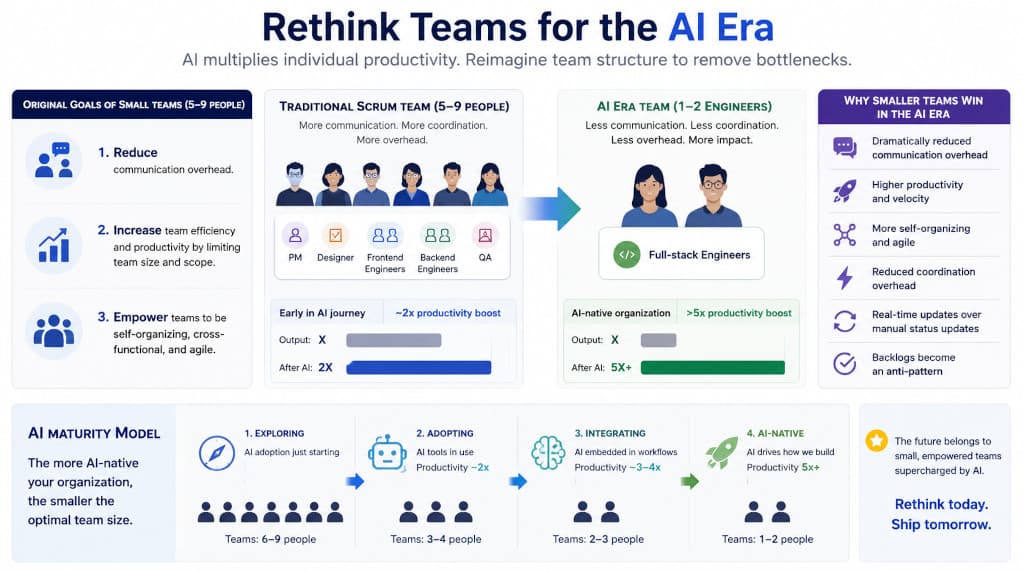
Stepping back in time, scrum team size was originally kept small to reduce the amount of communication overhead, to contain the scope of the work that a team could do, and to maintain high productivity. With this context in mind, it's clear that the original goals are still valid:
- Reduce the amount of communication overhead.
- Keep scope at a manageable level.
- Maintain high productivity.
While the goals are still valid, the solution is no longer correct. The traditional team size of 5 to 9 people is not a good fit for the AI-native world. Why? First, engineers can now handle an increase in scope while increasing velocity. Fewer engineers reduces the amount of communication overhead.
AI-native teams will operate with a smaller scrum team size.
Perhaps one of the biggest ones that we've seen is that, as the output of an individual engineer expands massively, they can actually get a lot more work done. What this means ultimately is that the scope of the work that they can do starts to increase quite a bit. That requires us to rethink the Scrum Team size. Now, one of the reasons Scrum Team sizes are the way they were is they were big enough to be efficient and small enough to not have a massive communication overhead. Now, as we go to an AI-native process, a couple of things start to happen:
- The sheer volume of work that a person puts out goes up.
- With too many people working in the same repo, or, very specifically, with too many people working on the same related areas of technology of the product, they can clash a lot more frequently than they used to. Whereas before maybe over the course of a quarter there were three or four main sequencing challenges or dependency challenges, today that can happen ten times faster because work is happening ten times faster. You're going to have ten times as many of those. With this scope, there are a couple of ways to solve it:
- To simply create new bottlenecks in the system.
- To recognize that a Scrum team can actually get a lot smaller. With a single designer, a single PM, and one or maybe two engineers at most, you can actually get the output of an entire Scrum team, if not two. What this means is you can start to reduce collaboration and coordination overhead. The other thing that it also means is that a lot more work can get pushed into any given sprint. What we're seeing is how to unlock bottlenecks that emerge by either process changes, retraining our teams, or changing our team structure. One of the biggest ones is reducing that friction in the team structure. Now, to take that even further, if you have either a product that is not very complex and you have a technical PM, you may actually be able to get down to some design input. For example, guidance from a designer, maybe with a component system and things like that, so that the product manager and the engineer don't have to constantly make design decisions. What can happen is either a technical PM or a product-advocating engineer can actually go a lot further all on their own. That would be the ideal team size. If you can get the team down to two people, maybe even one person for some areas, the amount of communication overhead goes down dramatically. You regain that massive productivity that you had when you were a startup first getting started, and it allows your organization to really expand either the depth or the breadth of its functionality. The reason that matters is when you look at the customer backlogs, all those customer requests that have sat around for a long time. AI gives a real opportunity to work through these customer request backlogs that can actually drive your revenue and your business. We can get there by reducing the Scrum team size.