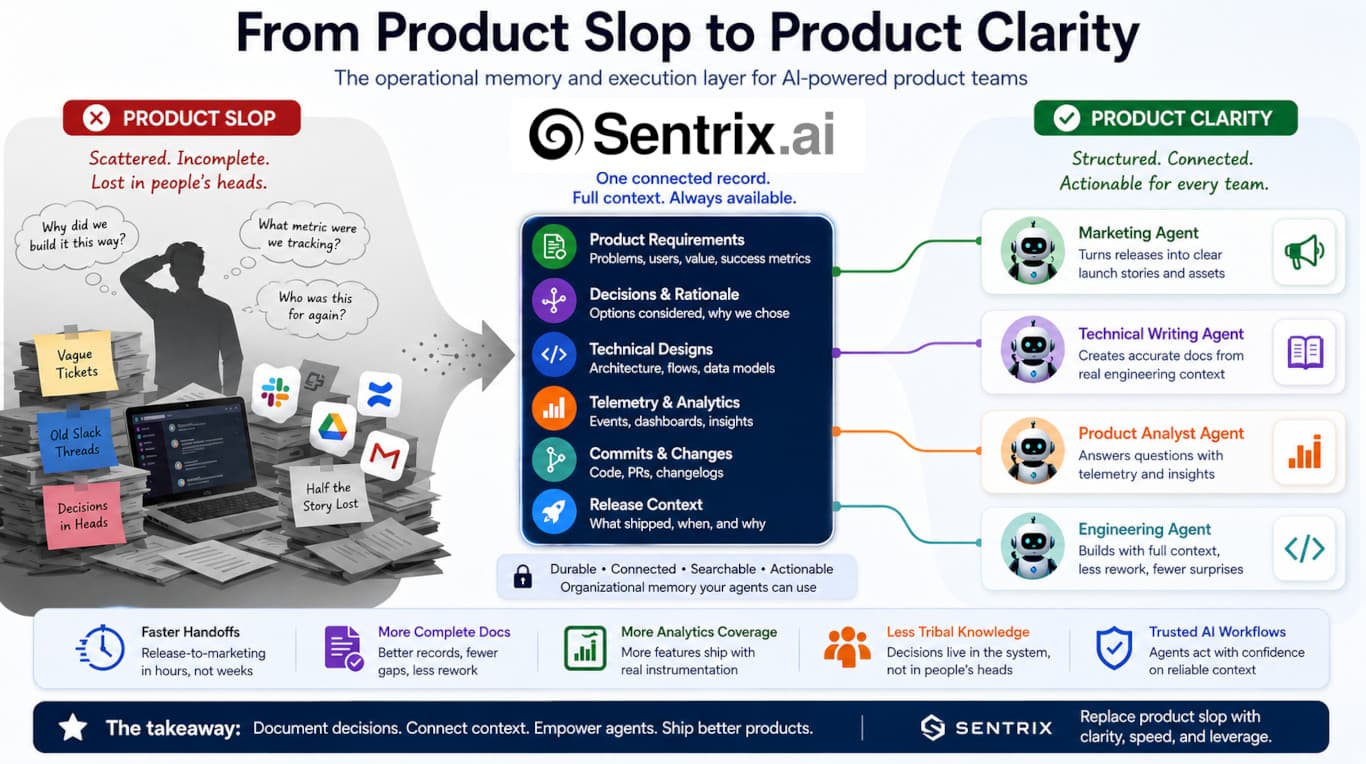
Ending the Era of Product Slop
Most product work runs on memory. The reason a feature shipped the way it did, the tradeoff someone made in a hallway conversation, the metric a PM promised to keep an eye on, the customer problem buried under a one-line ticket. Most of that lives in people's heads and a scatter of email, Slack, Jira, Confluence, and Google Docs. It held together, barely, when humans did all the work and could fill the gaps by asking around. It stops holding the moment you hand part of the work to AI agents.
We already have a name for what AI produces when it runs without good inputs. We call it slop. The same thing has been true of product work for years, and almost nobody named it. Vague tickets. Decisions nobody wrote down. Context spread across six tools. Handoffs that drop half the story on the way to the next team. Business rationale that exists only in the head of the person who left in March. That is product slop, and AI is about to make it impossible to ignore.
The problem was always there
Product work usually happens with incomplete context. A backlog gets written quickly, requirements stay thin, and the people downstream are left to guess at intent. Analytics get wired up inconsistently, so plenty of features ship without a clean way to tell whether they worked. The assumptions behind a bet, who it was for and what it was supposed to improve, rarely make it into writing. By the time the work reaches marketing, customer success, or the tech writing team, the information shows up late and in fragments.
Teams have absorbed this cost for a long time because humans are good at papering over gaps. Someone always knows who to ask and how to interpolate based on tribal knowledge. AI agents do not have that instinct. An agent only knows what you give it. When the organizational knowledge is thin or scattered, the output gets thin and scattered right along with it. That is the real ceiling on how far AI agents can take you, and it has very little to do with the model.
AI raises the bar
A lot of teams hope AI will let them skip the unglamorous work of writing things down. In practice the teams getting the most out of AI are the ones that already document requirements, technical designs, assumptions, telemetry, and release context as a habit. Structure is what lets an agent act with confidence. The better your record of what you decided and why, the more of the work you can safely hand to an agent.
This is also why treating AI as a coding accelerator alone leaves most of the value on the floor. Code is one slice of the product lifecycle and the customer value creation lifecycle. The bigger opportunity is using AI as a cross-functional execution layer that carries context from the first requirement all the way through release and into the hands of every team that depends on it.
What good looks like
Five things separate teams that beat product slop from teams that keep living in it.
1. Product decisions get a durable record. Not just what shipped, but what was considered, why a path was chosen over the alternatives, and how success will be measured. When that record exists, nobody has to reverse-engineer intent six months later, and an agent can reason about the work the same way a senior PM would.
2. Technical designs hold the line. Written designs reduce drift and protect architectural intent as a system grows. They also give AI agents something solid to build against, which means less technical debt accumulating quietly in the corners.
3. Instrumentation turns bets into learning. When features ship with full telemetry, product decisions stop being anecdotal. You get to see what actually happened instead of listening to the loudest voice in the room.
4. Release handoffs become flows. The moment engineering finishes a release, the relevant context can move automatically into marketing, customer success, and technical writing. The handoff stops being a slow manual process. Instead, the handoff becomes a pipeline.
5. Cross-functional agents share context. The leverage compounds when agents across the lifecycle draw on the same underlying record. Marketing, support, and docs are not each starting from scratch. They are all working from the same source of truth.
Where Sentrix fits
Sentrix is the operating layer for this. It documents product requirements, telemetry, user value assumptions, technical designs, architecture, commits, and release context, and keeps them connected rather than scattered across tools. Downstream teams get complete information they can act on instead of a partial picture they have to rebuild from memory.
The marketing handoff is a concrete example. The Sentrix GTM agent ingests the engineering work and synthesizes it into marketing-ready context, so the story of what shipped does not have to be reconstructed by hand every release. The time from engineering deploying a new feature to marketing getting a brief becomes instantaneous. The same pattern extends to customer success and technical writing, where the same underlying records drive the handoff and each team gets what it needs in a form it can use.
How you know it is working
A few things move when product slop starts going away.
Release-to-marketing handoffs get faster. Product and technical documentation gets more complete. More shipped features come with real analytics coverage behind them. Fewer decisions depend on tribal knowledge that walks out the door when someone leaves. Product updates ship with clear user telemetry to measure actual value creation against the assumed improvement that justified the initiative. And teams start trusting their cross-functional AI workflows enough to actually rely on them.
The takeaway
If your product org runs on memory and good intentions, AI will expose every gap you have been carrying. The teams that win the next few years are the ones that build a durable system of record now, while it still feels optional.
Sentrix replaces product slop with structured decisions, reliable handoffs, and organizational memory your agents can actually use. If you want to see what that looks like for your team, let's talk.