The New Knowledge Worker
AI is creating the need for a new skill set. The knowledge worker is not disappearing, but the job is changing.
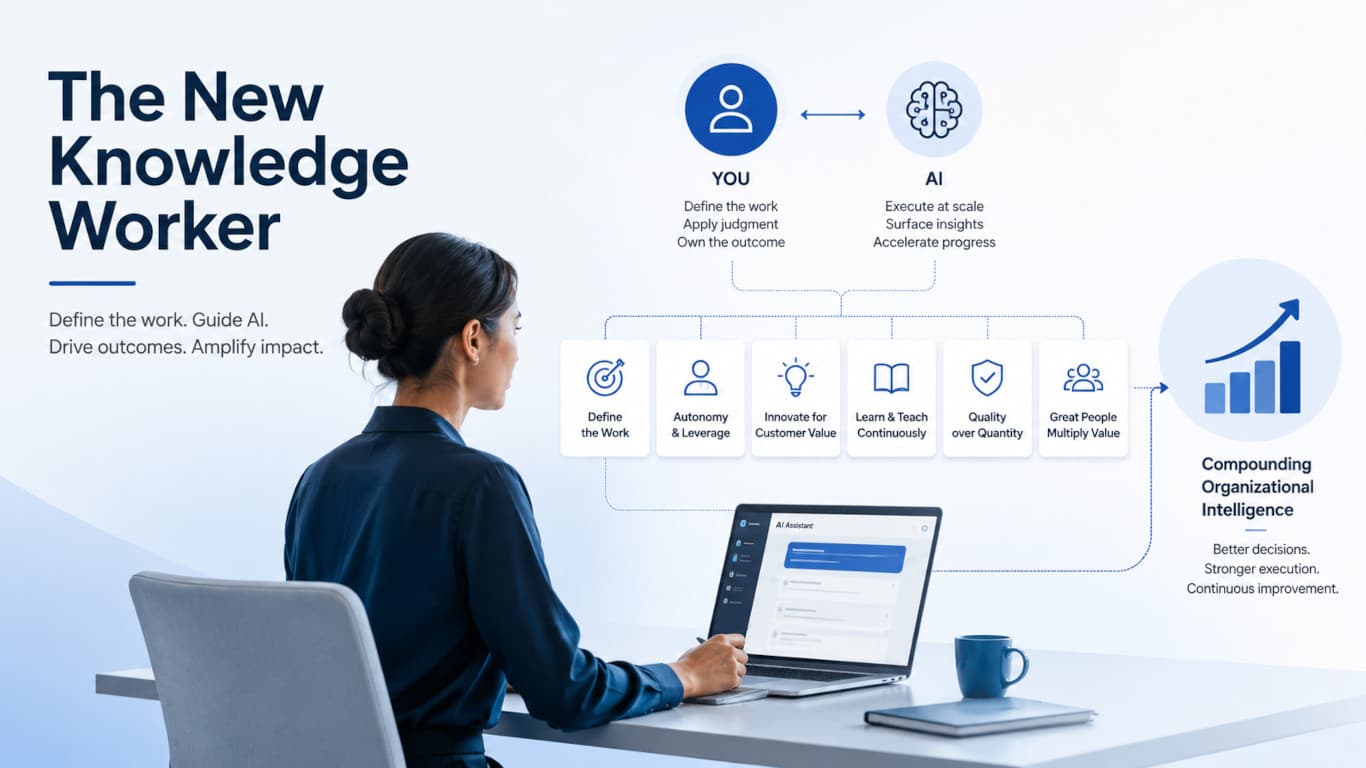
Peter Drucker defined knowledge worker productivity around six principles: define the task, preserve worker autonomy, pursue continuous innovation, keep learning and teaching, prioritize quality over quantity, and treat people as assets rather than costs. Those principles still hold. What has changed is the set of tradeoffs underneath them.
The biggest shift is that once a task is clearly defined, AI can increasingly execute it. That moves human leverage toward the work that happens before and after execution: choosing the right problem, understanding the process, applying judgment, reviewing quality, and making sure what gets learned becomes useful to the organization.
Define the Work
Defining the task matters more than ever. What should the work be? How is quality measured? What context is required to do it well? Which constraints matter, and which tradeoffs are acceptable?
The person who can answer those questions has leverage. They can delegate execution to AI because they understand the work well enough to direct it. They know what outcome matters, what information belongs in the work, and how the result should be reviewed.
In an AI-native organization, that definition also has to be captured. Processes, decisions, lessons, and examples cannot stay trapped in conversations or individual memory. If the organization wants to compound what it learns, the knowledge around the work needs to become part of how the company operates.
The work itself matters. The knowledge around the work matters just as much.
Autonomy Becomes Leverage
Before AI, a manager delegated a task, waited for output, reviewed it, and repeated that loop.
AI changes the loop. When the work is clear enough, a person can delegate parts of execution to AI. That makes traditional delegation less valuable. If someone needs to be told every next step, the manager may be able to give those instructions directly to an AI system.
The new knowledge worker owns outcomes. They notice what needs to be done, understand why it matters to the business, make progress without waiting for someone else to assign every task, and bring judgment back to the result. Proactivity becomes more important because the cost of execution is falling.
High-agency people can use AI to extend their reach because they already know where they are trying to go, how the work connects to business goals, and what constraints the team has to respect.
Innovation Has to Create Customer Value
AI makes invention easier to explore. New techniques, prototypes, and experiments can appear quickly. That speed is useful, but it can also distract teams from the more important question: does this improve how we deliver customer value?
There is a useful distinction between invention and innovation. Invention is a new technique. Innovation is a better way to create customer value and bring that improvement into day-to-day work.
That distinction matters more as AI becomes a regular part of work. Teams can generate more options than they can absorb. The valuable worker avoids novelty for its own sake. They use AI to test better workflows, remove friction, improve quality, and increase the pace of meaningful improvement.
The practical test is simple: does the change help the customer, improve the process, or make the organization better at delivering value?
Learning and Teaching Become Infrastructure
AI is an amplifier. If an AI agent doubles a person's output, then improving that person's knowledge and efficiency also gets amplified. The more a person learns, the more leverage they can pull through the system.
Teaching changes too. In the past, teaching mostly meant helping the team. Now it also means feeding knowledge back into the organization itself. That means writing down tribal knowledge. It means capturing the lessons that are usually discussed but never recorded. Knowledge capture has to happen everywhere.
This is where many teams will either compound or stall. If each person learns in isolation, AI may make individuals faster while the organization struggles to make significant gains in value creation. If learning is captured and made usable, every project can improve the next one.
Documentation, examples, process notes, lessons, and shared context become part of the work itself. They are how individual judgment turns into organizational intelligence.
Quality and Quantity Move Together
The pre-AI relationship between quality and quantity changes shape. AI lowers the cost of producing more. The limiting factor becomes the amount of usable work a team can create and absorb.
That puts quality at the center. When quality rises, quantity can rise with it because less work has to be discarded, repaired, or regenerated.
This is one reason average task execution becomes less distinctive. A team can produce more drafts, analyses, plans, and variants than before. The scarce skill is deciding what is worth producing, knowing when the output is wrong, and improving the guardrails so the next output is better.
AI-assisted quantity without review creates noise. AI-assisted quality creates operating leverage.
Great People Become More Valuable
The replacement narrative assumes that if AI can do more tasks, people become easier to swap out. That misses the compounding effect of context.
A high-context, high-agency employee becomes less replaceable, not more. They understand the work, the customer, the organization, the constraints, the history, and the quality bar. They learn continuously and feed that learning back into the company. When that person uses AI well, their judgment and organizational knowledge compound.
Replacing that kind of person is expensive because the loss extends beyond task capacity. The organization loses more than the individual's output. It loses a multiple of that output and has to restart the compounding process.
This is the definition of the new knowledge worker: someone who understands their role deeply, acts proactively, works autonomously, collaborates across functions, improves quality, learns continuously, and teaches the organization what they learn.
The bar is higher. Waiting for assignments and completing narrow tasks will create less leverage over time. The durable opportunity is to become the person who can define the right work, direct AI toward useful execution, review the result with judgment, and turn every lesson into shared organizational capability.
The result is an organization that keeps improving over time.